Business Scenario
Application Scenarios
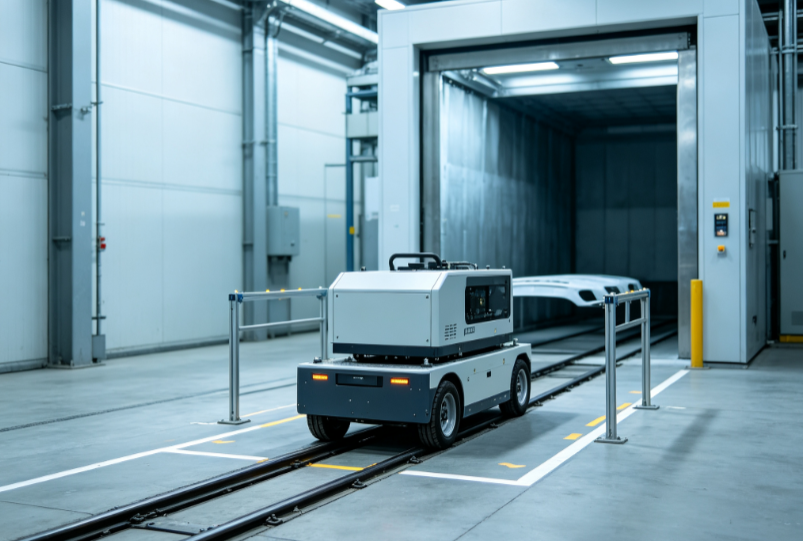
This project applies to an automated spray coating production line, solving the automatic positioning of spray carts after they enter a designated station.
Before coating begins, the system uses LiDAR to detect the relative position between the spray cart and the workpiece, obtaining distance and angle deviation, and completes automatic adjustment through the control system so the spray equipment maintains a proper coating posture.
The solution mainly applies to:
·pre-positioning of spray carts at stations;
·posture calibration of spray equipment;
·automatic adaptation for workpieces of different sizes during production.
Project Background
As manufacturers' requirements for automated coating efficiency and product consistency keep rising, the traditional approach of manually adjusting spray equipment position is increasingly unable to meet production needs.
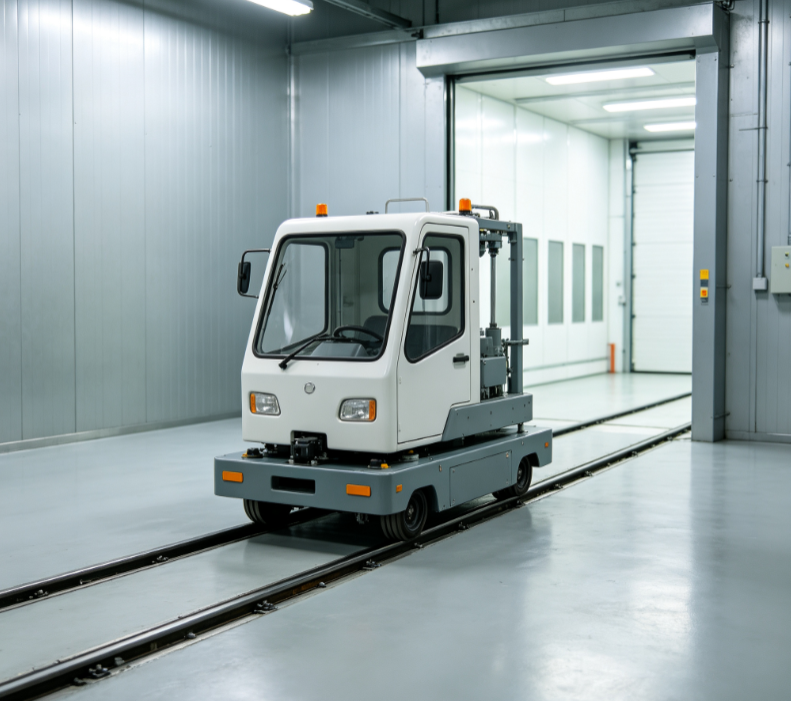
In actual production, after the spray cart reaches its station, it must keep a stable coating distance from the workpiece and ensure the gun maintains a proper angle to the workpiece surface.
Traditional approaches require operators to adjust manually by sight or measurement, suffering from limited adjustment efficiency, inconsistent repeat positioning and weak adaptability to production changes.
The customer therefore wanted automated sensing technology for automatic detection and position correction after the spray cart enters its station, improving coating stability and automation level.
Customer Challenge
Core Customer Problem
1. Manual adjustment depends on experience, with inconsistent positioning
Traditional spray equipment positioning relies mainly on manual observation and adjustment, demanding operator experience. Manual judgment errors may cause positioning deviation across different production batches, affecting coating stability.
2. Distance and angle deviation affect coating quality
During coating, the distance between the cart and the workpiece and the gun angle directly affect the result. Positioning deviation may cause:
·uneven coating coverage;
·inconsistent film thickness;
·increased rework cost.
3. Workpiece variation lowers adjustment efficiency
For workpieces of different sizes, the traditional approach requires re-adjusting equipment position. With frequent production changes, manual adjustment takes too long and affects production rhythm.
Solutions
Implementation Plan
For the customer's automatic coating positioning needs, Neuvition provides a 3D LiDAR-based alignment and guidance solution. The system uses LiDAR to obtain workpiece spatial information, detects the relative distance and angle between the spray cart and the workpiece, and feeds the calculation results back to the PLC control system for automatic adjustment.
System workflow:
·Step 1: workpiece space detection
After the spray cart enters its designated station, the LiDAR starts and scans the target workpiece to obtain spatial point cloud data.
·Step 2: deviation calculation
The system calculates the current distance and angle deviation between cart and workpiece from the detection data.
·Step 3: automatic position correction
The PLC receives the LiDAR feedback data and controls the spray cart to adjust position and angle.
The system continuously executes:
detect → calculate → adjust → re-detect
as a closed loop until the set requirements are met.
·Step 4: entering the coating process
When the equipment posture meets the requirements, the system outputs a Ready signal to the PLC, allowing the coating process to start.
Deployment & Installation
The solution mainly consists of:
1. LiDAR
Responsible for collecting workpiece spatial information and acquiring 3D data of the target area.
2. Data processing module
Analyzes point cloud data and calculates the positional relationship between the spray cart and the workpiece.
3. PLC control system
Receives LiDAR output data and controls the cart to complete automatic adjustment.
4. Spray equipment
Proceeds with subsequent coating based on the positioning result.
System Integration
The system exchanges data with the on-site PLC control system.
The LiDAR outputs:
·distance deviation;
·angle deviation;
·positioning completion status.
The PLC controls the spray cart movement based on the feedback data, achieving closed-loop automatic positioning control.
Case Value
Case Highlights
1. LiDAR replaces manual measurement for automatic pre-positioning
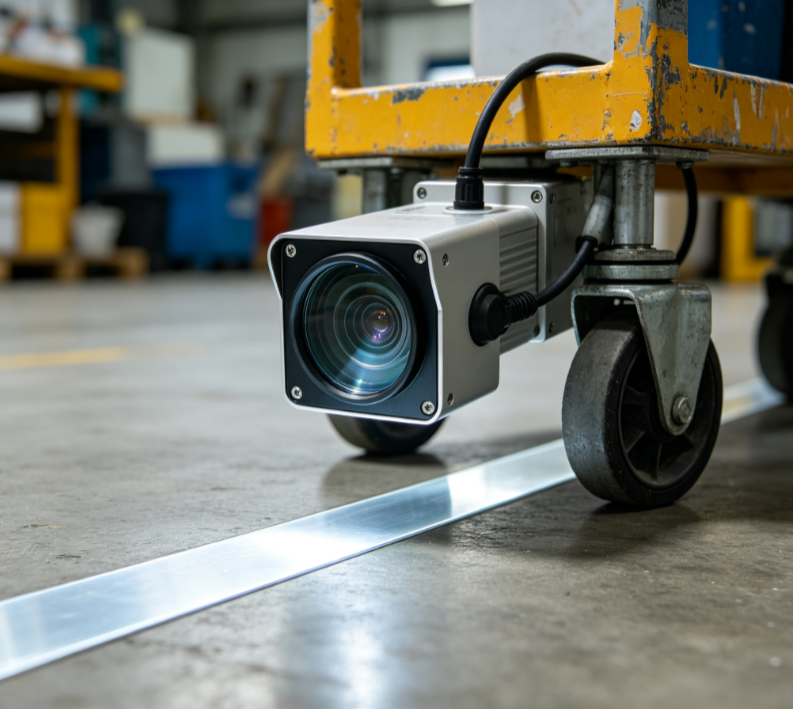
Through non-contact 3D detection, the system automatically obtains the positional relationship between equipment and workpiece, reducing dependence on manual adjustment.
2. Closed-loop control improves positioning stability
The solution uses a real-time detection and feedback mechanism, continuously correcting to keep the spray equipment in a stable posture and improving repeat positioning consistency.
3. Adapts to different workpiece production needs
Compared with fixed-parameter adjustment, LiDAR spatial sensing obtains target information and supports positioning for workpieces of different sizes.
4. Coating-environment protection design improves reliability
Non-working-stage detection logic avoids long-term LiDAR exposure to the coating environment, reducing maintenance pressure.
Project Results
By deploying the LiDAR-guided system, the customer automated the spray cart positioning process.
The project improved the stability of the equipment alignment process, reduced manual involvement, and raised the operating efficiency and production consistency of the automated coating line.
Customer Concerns
Customer Concerns
1. Whether positioning accuracy meets coating process requirements
The distance and angle between the spray cart and the workpiece must remain stable.
2. Whether manual adjustment dependence can be reduced
Reduce the impact of operator experience and achieve automatic positioning.
3. Whether it adapts to complex industrial environments
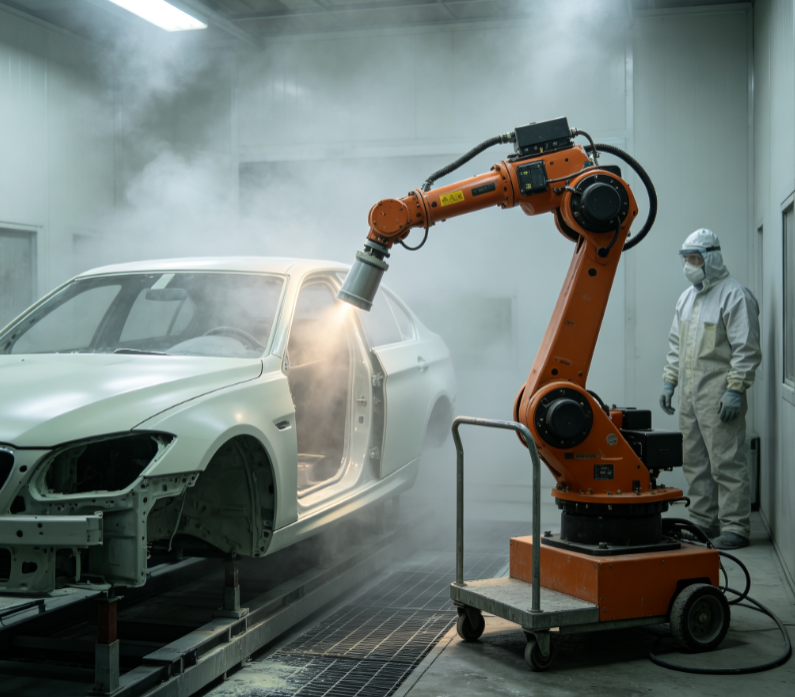
The equipment must operate long-term in production environments with paint mist, dust and other factors.
4. Whether it can be easily integrated into existing production lines
The solution must work with the on-site PLC and automation control systems.