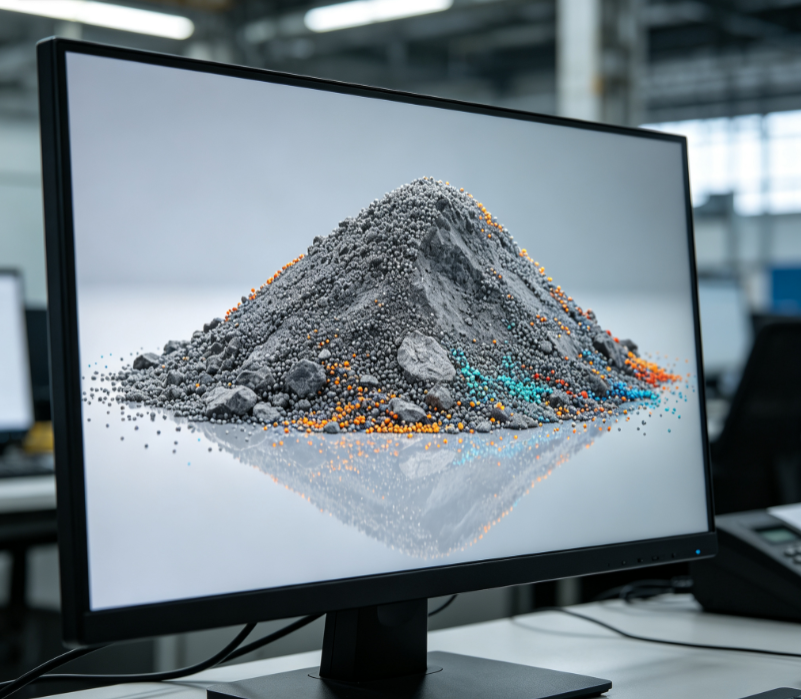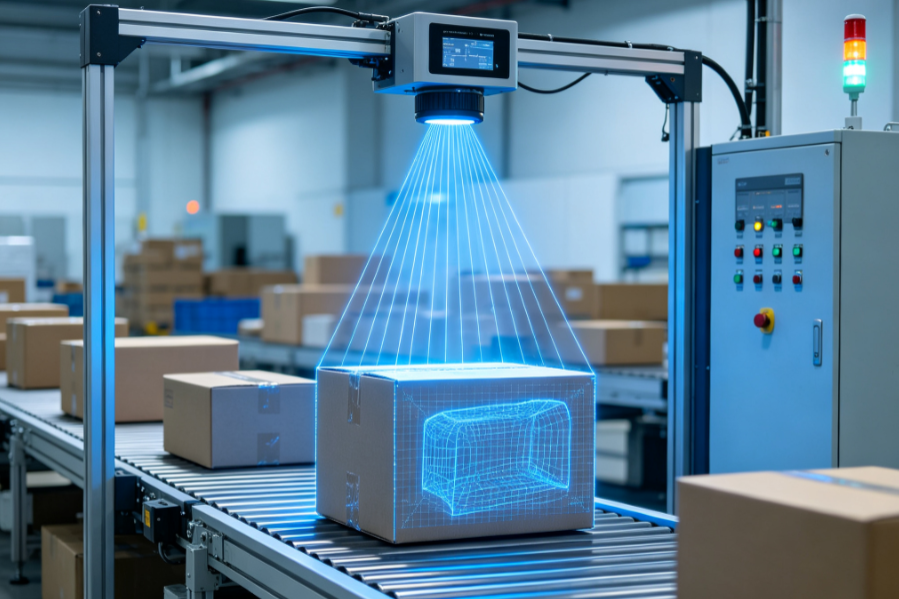
This article explores the optimization strategies for point cloud filtering, registration, and modeling algorithms in Neuvition CloudEngine, demonstrating how algorithm engineering delivers millisecond-level real-time volume calculation.
Point Cloud Filtering: Adaptive Multi-Echo Denoising
In high-dust environments such as mines and ports, LiDAR point clouds contain significant noise. CloudEngine uses a multi-echo adaptive filtering algorithm that dynamically distinguishes valid signals from noise based on echo intensity, range, and incidence angle. Compared with traditional fixed-threshold filtering, the adaptive algorithm preserves material surface details while reducing the residual noise rate to below 0.3%.
The core optimization introduces a cascaded strategy combining local point-density-based Statistical Outlier Removal (SOR) with normal-vector-consistency bidirectional filtering. SOR first removes outlier noise points, then normal-vector consistency checks retain continuous surface points. The two-stage cascade runs in parallel on the GPU, keeping per-frame filtering time for million-point point clouds within 5 ms.
Point Cloud Registration: ICP Acceleration and Coarse Registration
In dynamic measurement scenarios, multiple point cloud frames must be registered and stitched to obtain a complete 3D model of the material. CloudEngine adopts a two-stage coarse-to-fine strategy: coarse registration uses RANSAC feature matching to quickly estimate the initial transformation, while fine registration uses an improved ICP (Iterative Closest Point) algorithm for refined alignment.
We made two key optimizations to standard ICP: first, point-pair distance pre-filtering — only point pairs within an adaptive distance threshold participate in iteration, cutting 70% of ineffective computation; second, parallel KD-Tree nearest-neighbor search, reducing single-iteration time from 50 ms to 8 ms. The two-stage registration improves overall registration speed by 6× while maintaining accuracy.
Volume Modeling: TIN and Integral Fusion
The core of volume calculation is building a material surface model from point cloud data and computing the volume difference against a reference plane. CloudEngine fuses TIN (Triangulated Irregular Network) modeling with numerical integration: Delaunay triangulation first builds the surface TIN model, then the prism volume between each triangular facet and the reference plane is integrated and summed.
For irregular stockpiles and sloped terrain, we introduced an adaptive reference-plane fitting algorithm that automatically fits the reference plane from the stockpile base point cloud, avoiding systematic errors from fixed-plane assumptions. Field data shows volume error remains stable within 1% in complex stockpile scenarios.
Measured Performance
In the NV-S100 stockpile measurement scenario, CloudEngine’s end-to-end pipeline (filtering → registration → modeling → volume calculation) dropped from 3.2 seconds before optimization to 180 ms, meeting real-time inventory requirements. In the NV-T200 dynamic truck measurement scenario, per-vehicle processing time is under 200 ms, supporting continuous non-stop measurement.
Related Reading
- More insights from our blog
- Explore Neuvition measurement systems
- Dynamic truck volume measurement solution
Get a Tailored Measurement Proposal
Want to learn how LiDAR volume measurement solves your real-world problem? Contact us for a custom proposal and budget estimate, or request a demo.