Do You Face These Challenges Too?
Weighbridges provide weight only, not volume.
Manual measurement is time-consuming and error-prone.
Loading anomalies (off-center load) are hard to detect quickly.
Load data must be manually entered into management systems.
Separate entry/exit lanes make it difficult to link the same vehicle's empty and loaded data.
Application Scenario
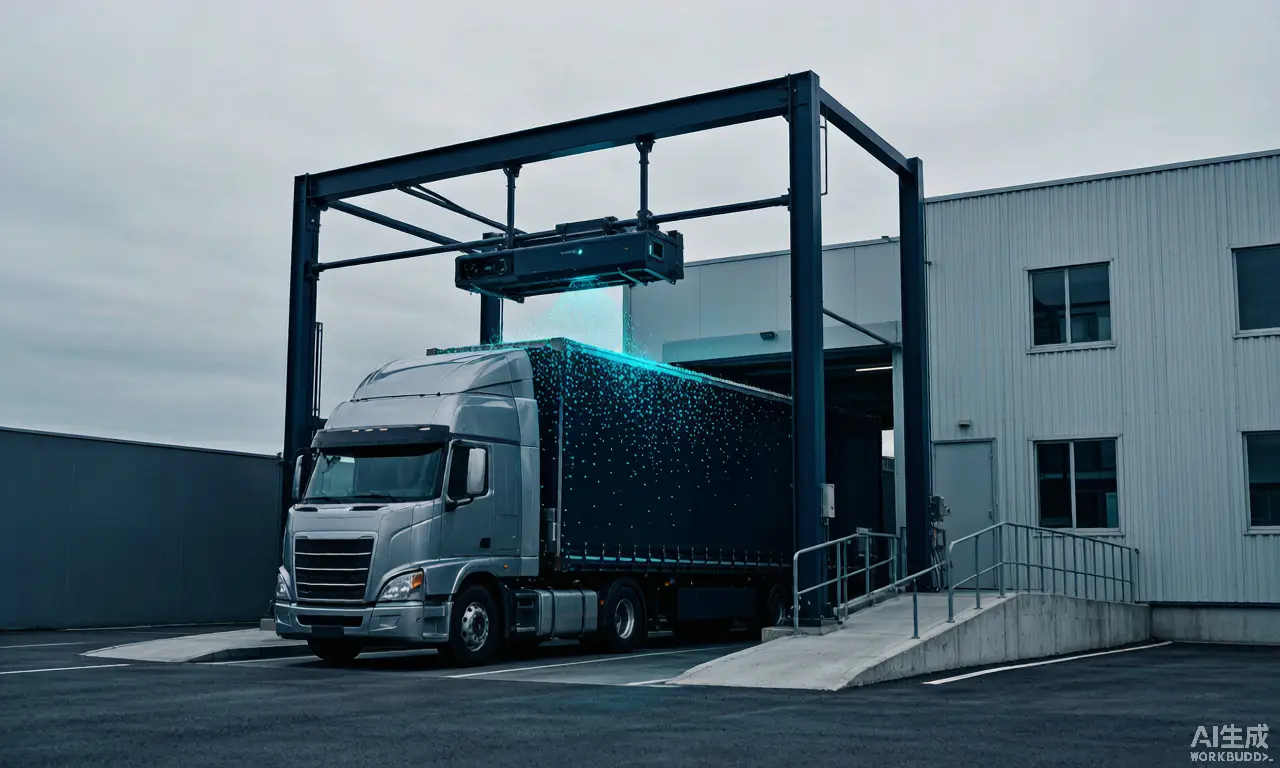
The truck parks still in the measurement area while a 3D laser scanner rotates to scan the truck bed and load, generating 3D point cloud data. Load volume is calculated by comparing empty and loaded states, then recorded and uploaded automatically. Each scan takes about 10 seconds.
Solution Overview
A 3D laser scanner mounted above the measurement station rotates to scan from one side of the truck to the other, capturing 3D point cloud data of the load surface. Neuvition's proprietary 3D reconstruction algorithm compares the point clouds of empty and loaded states to precisely calculate load volume. With an integrated RFID automatic identification module, the system supports automatic vehicle data extraction, volume measurement, data recording, and statistics, and integrates seamlessly with PLC control systems and upper-level management platforms.
Solution Highlights
- High-accuracy static scanning, ~10 seconds per scan
- Full-coverage rotating 3D scanner
- Automatic truck bed dimension recognition
- Multi-station deployment with entry/exit comparison
- Supports large trucks over 10 m in length
- Seamless PLC control system integration.
System Components
3D laser scanner, control unit (LCU / edge computer lw-3610), power cabinet (LCC), RFID or ANPR vehicle identification module, LED display (optional), network camera (optional), volume measurement software (VI-TVM-3D-S)
Key Parameters
| 3D laser scanner, ToF ranging, measurement range 0.1–40 m (10% reflectivity) / 0.1–70 m (90% reflectivity), FOV 360° horizontal × 59° vertical, angular resolution 0.25°/0.05°, sampling rate 360,000 points/s, frame rate 10 Hz, IP65. Static scan time ~10 s; accuracy ±3% (12–25 m³) / ±2% (>25 m³); installation height ≤7.5 m. Operating temperature −20 °C to +50 °C. Applicable vehicle size: 4000–18000 mm × 2000–3000 mm × 2000–4000 mm. Trucks over 10 m require two 3D scanners per station — one mounted above the front and one above the rear. |
Reference Scenarios (Anonymized)
- Coal truck volume measurement: at a coal mine transport site, the system scans trucks in empty and loaded states for automatic load recording and anomaly review.
- Biomass power plant fuel truck measurement: volume measurement of biomass fuel transport vehicles to support fuel intake management.
- Cement plant clinker truck measurement: deployed at the raw-material transport stage for automatic clinker load statistics.
- Grain sampling inspection truck measurement: in a grain storage inspection scenario, the system assists with grain load volume measurement and data recording.
Competitors / Alternatives
Weighbridge, manual measurement, vision camera solutions, drone surveying, handheld LiDAR surveying
Customer FAQ
Does the vehicle need to stop during measurement?
Yes — the truck must park still beneath the measurement station; each scan takes about 10 seconds.
How is the system installed?
A 3D laser scanner and power cabinet are mounted above the station; the system is ready after calibration.
Can it integrate with PLC and management systems?
Yes — direct PLC communication via supported protocols, plus an API for upper-level management systems.
Does dust or rain affect measurements?
Light rain or snow is acceptable; heavy dust or water vapor can affect accuracy.
What is the measurement accuracy?
±3% (12–25 m³) and ±2% (>25 m³).
How long does a scan take?
About 10 seconds in standard mode, with results available after roughly 30 seconds. Actual time depends on truck position and tilt angle.
Full workflow from survey to delivery
Site survey
Engineers assess the measurement station environment and determine the installation plan.
Installation
3D laser scanner, control unit, power cabinet, and identification modules are mounted above the station.
Calibration
System calibration and empty-state baseline collection, integrated with PLC and the management platform.
Handover & training
System acceptance, then operator and maintenance training.