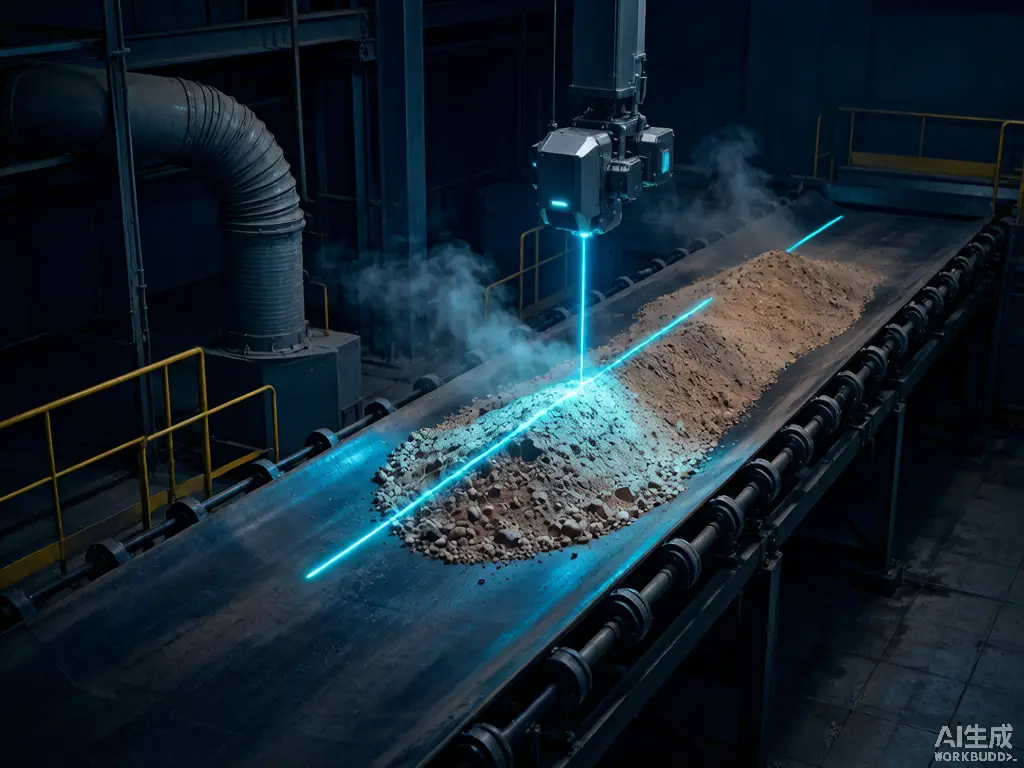
From scanning to results — a fully automated chain
LiDAR mounted across the belt scans the material flow cross-section → per-frame cross-sectional area × belt speed = instantaneous flow → integrated into cumulative volume → convert to tons with density reference → optional industrial camera for particle size analysis.
LiDAR mounted across the belt scans the material flow cross-section
per-frame cross-sectional area × belt speed = instantaneous flow
integrated into cumulative volume
convert to tons with density reference
optional industrial camera for particle size analysis.
Accurate to Every Millimeter
Parameters below are sourced from the product database; the official technical datasheet is authoritative.
Measurement Performance
| Metering accuracy | Cumulative error ≤1% (under stable conditions) |
|---|---|
| Flow measurement | Real-time cross-section scanning × belt speed |
| Measurement frequency | ≥50 Hz |
Environmental Parameters
| Protection rating | IP67 |
|---|---|
| Operating temperature | −25 °C to +55 °C |
Other Parameters
| Data output | 4-20mA / Modbus / OPC UA / REST API |
|---|---|
| Dust handling | Built-in dust filtering algorithms |
| Particle size extension | Optional industrial camera |
| Installation | Mounted across the belt, non-contact |
These Scenarios Are Draining Your Profit
Typical problems and costs of traditional measurement
Belt scale drift requires frequent calibration
Contact-based belt scales drift with mechanical wear and require monthly calibration with downtime.
Misalignment and tension affect accuracy
Belt misalignment and tension variation directly shift the weighing baseline, amplifying errors.
No real-time flow visibility
Cannot detect off-center loading, material loss, or blockages in real time; manual sampling is inefficient.
Why Neuvition
Non-contact, maintenance-free: no mechanical contact parts, no wear, no misalignment effect — goodbye to frequent calibration
Flow visualization: real-time 3D display of the material cross-section — off-center loading, material loss, and blockages visible at a glance
Long-term stable accuracy: no drift source; calibrate once at installation, effective long term
Seamless DCS integration: standard industrial interfaces feed the control room directly, with production data displayed in real time
Particle size monitoring extension: add a camera to monitor particle size distribution simultaneously