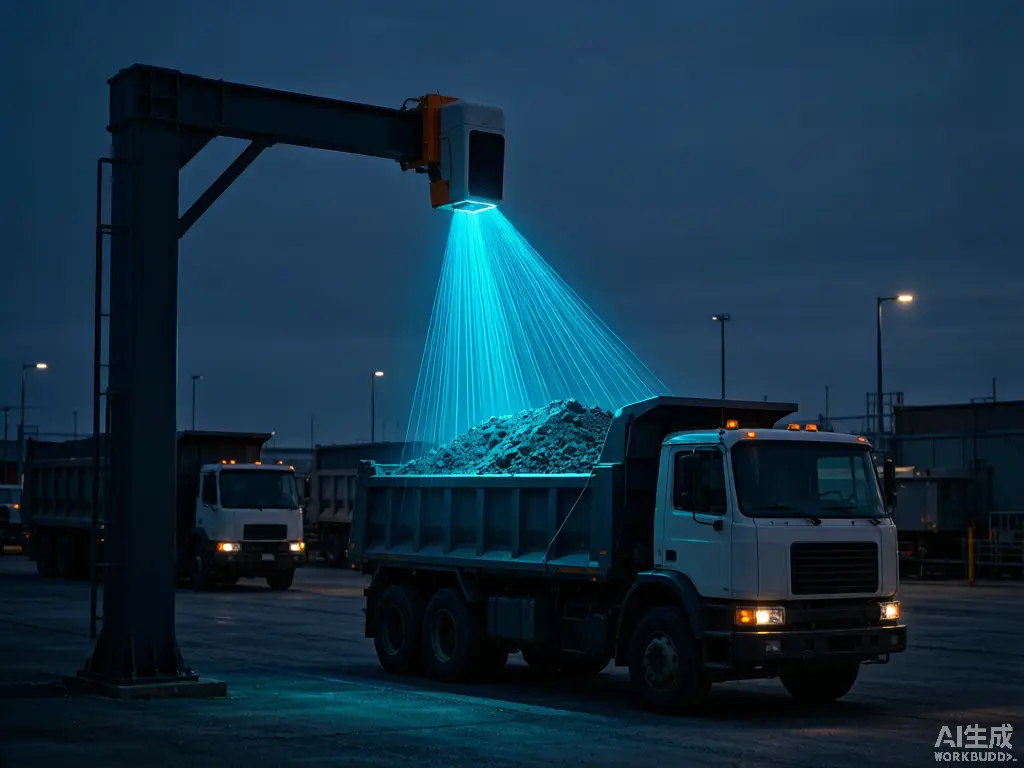
From scanning to results — a fully automated chain
Two single-line LiDAR sensors are mounted vertically above the measurement lane (LiDAR 1 + LiDAR 2): LiDAR 1 scans the truck cross-section profile while LiDAR 2 detects vehicle speed. Data from both sensors is fused into a 3D point cloud, and a 3D reconstruction algorithm automatically compares empty and loaded states to calculate load volume.
Two single-line LiDAR sensors are mounted vertically above the measurement lane (LiDAR 1 + LiDAR 2): LiDAR 1 scans the truck cross-section profile while LiDAR 2 detects vehicle speed. Data from both sensors is fused into a 3D point cloud, and a 3D reconstruction algorithm automatically compares empty and loaded states to calculate load volume.
Accurate to Every Millimeter
Parameters below are sourced from the product database; the official technical datasheet is authoritative.
Optical Parameters
| Field of view | 270° |
|---|---|
| Angular resolution | 0.25°/0.5° |
Measurement Performance
| Measurement accuracy | ±3% (12–25 m³) / ±2% (>25 m³) |
|---|---|
| Dynamic measurement speed | <5 km/h |
| Measurement range | 1–80 m (90% reflectivity) |
Environmental Parameters
| Protection rating | IP65 |
|---|---|
| Operating temperature | −25 °C to +50 °C (standard) / −55 °C to +70 °C (wide-temp VI-K30) |
Other Parameters
| LiDAR model | VI-K30 (single-line LiDAR) ×2 |
|---|---|
| Sampling rate | 36,000 points/s |
| Frame rate | 25/50 Hz |
| Installation height | ≤7.5 m (recommended), up to 9 m |
| Applicable vehicle size | 4000–18000 mm × 2000–3000 mm × 2000–4000 mm |
| Vehicle recognition | RFID / ANPR |
| Data output | Volume reports / point cloud / API |
| System integration | PLC direct connection + API |
| Optional accessories | License plate camera, LED display |
| Software | VI-VMS-D volume measurement software |
These Scenarios Are Draining Your Profit
Typical problems and costs of traditional measurement
Weight only, no volume
Weighbridges provide weight only and cannot obtain volume information.
Manual measurement is slow and error-prone
Manual measurement is time-consuming with large errors, and loading anomalies (overload, off-center load) are hard to detect quickly.
Data not integrated
Load data cannot automatically enter management systems and requires manual entry; separate entry/exit lanes make it difficult to link empty and loaded states.
Why Neuvition
Dynamic scanning with no stopping: vehicles pass through the measurement lane at a steady speed below 5 km/h
Automatic 3D truck bed dimension recognition: no manual intervention — volume is obtained as the truck passes through the scanning area
Multi-lane entry/exit measurement: supports multi-lane deployment with automatic empty/loaded state correlation
Bidirectional measurement: automatic vehicle orientation detection for both entry and exit
Automatic truck bed rib recognition: intelligently removes rib interference to avoid volume misjudgment
Seamless PLC integration: direct PLC communication via supported protocols, plus API for upper-level systems